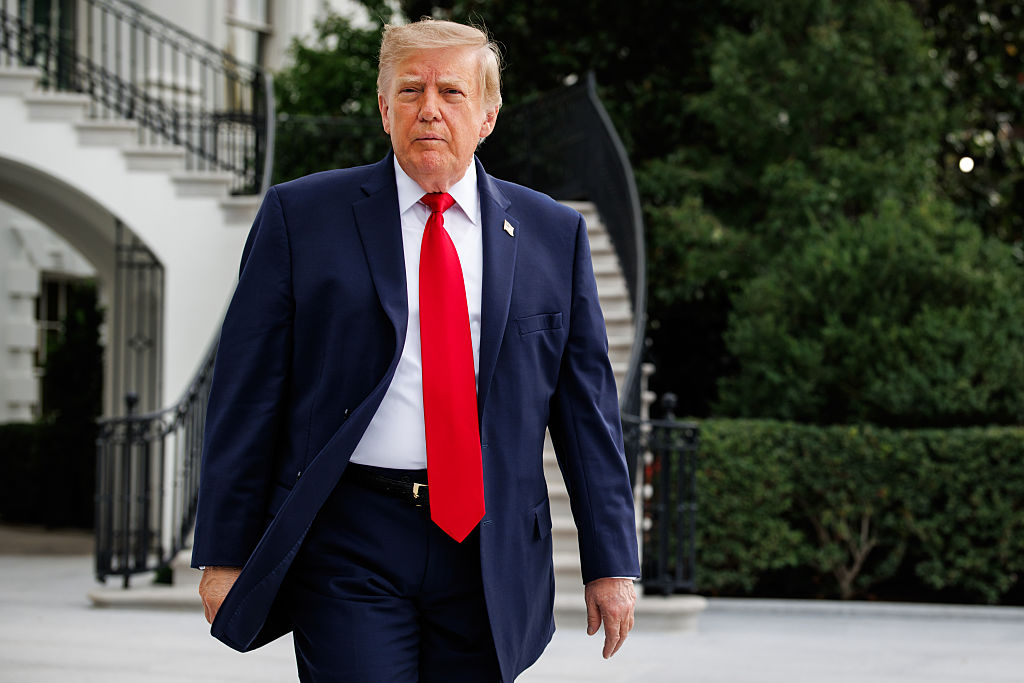
President Donald Trump announced Friday that he is seeking to cancel almost $1 billion in federal funding, sidestepping congressional approval and earning criticism from lawmakers on both sides of the aisle.
Using a controversial move known as a “pocket rescission,” Trump said he wanted to nullify $810 million in spending that Congress had approved for programs and agencies, much of which would serve immigrants, minorities, and children.
Read More: A Debt Ceiling Fight Looms in 2027. Could a Democratic Congress Make it the Last One?
Over half of the cuts would land on the Health and Human Services (HHS) Department’s Office of Refugee Resettlement, according to a request sent to House Speaker Mike Johnson on Friday. It said that rescinding the funds is “consistent with the Administration's goal of ending the use of Federal taxpayer dollars to support non-citizens, putting Americans first.”
In a statement accompanying the request, the Trump Administration also called the funds “wasteful” and “harmful.”
The Government Accountability Office (GAO), a nonpartisan government watchdog, has asserted, however, that the move is an illegal sidestepping of the constitutionally protected separation of powers—chiefly, Congress's power of the purse.
What is a pocket rescission?
A “pocket rescission” is not a formal or legal term; it was coined to reference a “pocket veto,” a process in which a bill fails to become law because the President does not sign it within 10 days and Congress’s adjournment prevents its return. Similarly, the “pocket rescission” aims to withdraw allocated funding without direct congressional intervention.
The timing is important when it comes to pocket rescissions. In order to be fully effective, this “occurs when a president asks Congress to rescind (or cancel) funds very close to the end of the fiscal year—so close that the funds expire before they can be used for new obligations,” according to the U.S. Government Accountability Office (GAO).
The Office of Management and Budget (OMB), helmed by Director Russell Vought, submitted the requests Friday and holds that the move is valid under the 1974 Impoundment Control Act (ICA).
The Impoundment Control Act was created in response to President Richard Nixon’s heavy use of impoundments to achieve his policy goals. It has since been used to limit or regulate a president’s ability to control spending that has already been appropriated by building in 45 days of continuous congressional session. During this time, Congress is meant to review a President’s rescission requests and either approve them or see the funds released as planned.
Trump’s request to cancel $810 million in funding, however, came just five days before the end of the fiscal year on Sept. 30, all but ensuring that Congress will not have time to review the proposal in full or prevent the cuts from going into effect.
It is not the first time Trump has used this strategy to thwart spending attempts. He submitted a request on Aug. 28, 2025, to cancel $4.9 billion in foreign aid funds approved by Congress, including $3.2 billion that had been allocated to USAID. Although the move was contested, the Supreme Court last year stayed a lower court injunction requiring roughly $4 billion covered by the rescission request to be obligated.
The GAO claims that the move is illegal, writing on its website that this application of the ICA would “cede Congress’s power of the purse by allowing a president to, in effect, change the law by shortening the period of availability for fixed-period funds.”
“If Congress wanted a president to have that authority, it would need to change the law,” it continues.
Zachary Price, a professor at the University of California College of the Law, San Francisco, says that the move is an “abuse” of the ICA.
“It’s perverse to read that as, instead, creating this mechanism for unilaterally canceling funds,” Price tells TIME, adding that this interpretation is not supported by a lot of “historical practice.”
The maneuver seeks to withhold the funds until they expire at the end of the fiscal year, leaving Congress little time to respond.
In this case, Price says, it further showcases how the ICA is being manipulated.
The government “shouldn't have a lot of money left over at the end of the fiscal year if you've been spending it as you go in the way the statute contemplates,” he says.
He also points out that the American government is distinctly separated into three branches, with Congress, sitting in the legislative branch, being given the power to pass legislation—or, in this case, cancel funds that have already been appropriated. It has been explicitly separated from the authority of the executive branch and the President.
Bobby Kogan, the senior director of federal budget policy at the Center for American Progress, says it even plainer than Price: “The administration has picked a bunch of things that they hate, and they say, ‘Well, we're just not going to do those.’”
The Supreme Court’s intervention last year did not constitute a ruling on the authority of pocket rescissions, meaning that the Trump Administration's latest use of the tactic could face new legal challenges.
Which federal programs would lose funding and what’s at stake?
The largest portion of this year’s proposed cuts will target HHS programs providing nonprofit services for refugees and unaccompanied minors. Trump’s request would withdraw $567 million from those services.
The Department of Homeland Security (DHS) was also impacted, with a request to cancel funding for nonprofits that provide mental health services and social services to migrants. Another cut targets almost $25 million that had been slated for the Department of Education’s Special Programs for Migrant Students.
The Housing and Urban Development Department’s housing counseling services are also named amid the rescissions; the Trump Administration said that the program included non-governmental organizations with “divisive and DEI-centric agendas.”
The Trump Administration also aims to cancel $15 million from a Department of Justice office that focuses on reducing racial tensions, in addition to $10 million that had been allocated to the Minority Business Development Agency, which supports minority entrepreneurs.
“I assume that they're picking money to cancel based on some political calculus about what they can get away with,” Price says. When looking at the bigger picture, he argues this is just one maneuver in several to “establish stronger executive control over spending.”
The move also risks future negotiations in Congress, Price says. He explains that this application of the ICA would make it harder for Democrats and Republicans to compromise over spending if they anticipate that the sitting President will simply swoop in and cancel funding after thoughtful agreements have been reached.
“If the executive branch can come in and effectively impose a more kind of party line view of the spending, then you know why would people agree to the package in the first place?” he asks.
Can Congress stop Trump’s pocket rescission?
The rescission has earned blowback from both Republican and Democratic lawmakers who believe that the move sidesteps Congress's authority.
Republican Sen. Susan Collins of Maine, the chair of the Senate Appropriations Committee, lambasted the move on social media Friday evening, saying she would “work with my colleagues to address these illegal actions.”
“This move shows that OMB intentionally withheld these funds for months to execute this unlawful cancellation of appropriations that were approved on a bipartisan basis and signed into law,” Collins said. “OMB is an agency of the executive branch. It does not get to decide which programs are worth funding.”
Sen. Patty Murray of Washington, Collins’s Democratic counterpart on the Appropriations Committee, called the move “theft from the American people.”
“Every Republican who voted for these bills should be furious, because Vought is saying their votes don’t count,” Murray said in a statement on X.
The August 2025 pocket rescission was challenged in an existing lawsuit brought by nonprofits, including AIDS Vaccine Advocacy Coalition, over the Administration’s prior foreign aid freeze. In September, the Supreme Court allowed the funds covered by the rescission request to remain withheld while litigation continued. This year, similar lawsuits are likely to emerge—but how they might shape future ICA actions remains to be seen.
According to Kogan, this move sets up a potential battle in Congress to claw back these funds in the next fiscal cycle by reappropriating funds to the same programs.
“One thing that Congress could do is they could say ‘I know you illegally didn't spend it this year, but take that money we’re going to slap it right back on,’” he says. “That doesn't make [Vought] spend it next year, but it does say that we are going to make sure this money gets out the door, even if it's years late.”


