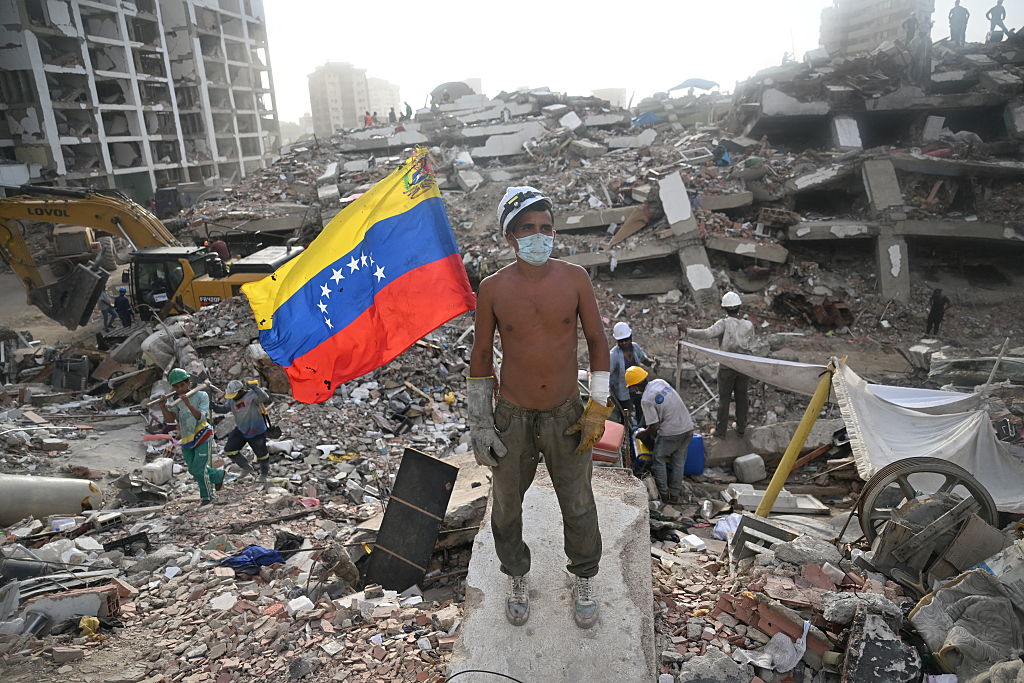
For decades after the 1967 Caracas earthquake, seismologists warned Venezuelans that a major earthquake was coming. And we had been waiting for the big one. On Jun. 24, the prediction of horror came true. Twice. Two level-seven magnitude earthquakes struck northern Venezuela, the most densely populated region of the country, in less than a minute.
That would test any country. It is harder for Venezuela in 2026: a country where half the people live in extreme poverty, the economy has been reduced to a fraction of what it once was, a quarter of its population was lost to mass migration in less than a decade, and the healthcare system is in ruins.
Living through the earthquakes felt like battling cancer and being struck by two cars in the same breath. At least 5,000 people perished, most of them in La Guaira state, a strip of cities and slums crammed between the coastal cordillera and the Caribbean Sea, half an hour from Caracas.
Amid the staggering destruction, the question of how many people are missing looms over the country. How many remain buried beneath the rubble? How many were lost in the chaos—a strong likelihood with children and elderly patients? In the absence of any official accounting, several online platforms solicited reports of missing relatives from survivors. Estimates range from 10,000 to around 30,000 missing persons.
The Venezuelan government has neither the capacity nor the will to produce an accurate death toll. The online public sphere was inundated with drone footage, satellite imagery, news coverage, and NASA maps laying bare the scale of the devastation.
Venezuela has run aground under a Chavista regime since 1999, when Hugo Chavez rose to power and created a regime combining left-wing populism, authoritarianism, petro-state largesse, and anti-Americanism. After Chavez died in 2013, Nicolas Maduro took over and hollowed out the country till his removal in January. The Trump Administration simply recycled the Chavista regime, with Delcy Rodriguez, a stalwart of the old establishment, as an interim president who offered compliance and national resources to Washington.
Throughout the Maduro years, the Chavista regime refused to publish crime and inflation rates. Few expect the Rodriguez government to offer a truthful accounting of the tragedy, one that the U.S. Geological Survey estimates may have claimed more than 10,000 lives.
For we live with a haunting question: How many Venezuelans would have survived if they were rescued in time? If only Venezuela had a government capable of responding and was not saddled with a zombie state that lurches forward only to shield a corrupt regime led by an illegitimate president.
Extract the dictator, nurture the dictatorship
Venezuela’s annus horribilis did not begin with the earthquakes. The big twos are a tragedy of historical proportions. Yet, for Venezuelans they are the latest in a series of bewildering shocks: in a year that has already delivered the first American military incursion in the country’s history, and the astonishing spectacle of a Chavista government, the long self-proclaimed vanguard of the radical left, submitting to President Trump with a docility that no Venezuelan government has displayed toward a foreign power since the republic’s founding in 1830.
Venezuela and the United States built a close, oil-driven relationship through much of the 20th century, a relationship marked by cooperation but also periodic tension over sovereignty and economic policy. Under Hugo Chávez, and more sharply under his successor Maduro, the relationship deteriorated into open hostility, shaped by the political stances of the Chavista regime and American sanctions and pressure. Trump weaponized that hostility, emphasizing a narrative of Maduro flooding American streets with fentanyl and mentally ill criminals.
Then, abruptly, on Jan. 3, the Trump Administration dispatched special forces to attack military targets, seize Venezuela’s most heavily guarded fortification, and extract Maduro and his wife. Most Venezuelans, who had watched Maduro steal the election he lost in 2024 and then crush the popular backlash that followed, peered through the smoke and realized that Washington had left the architecture of the dictatorship entirely intact. Venezuelans did not celebrate the tyrant’s capture. Nor did anyone protest the violation of national sovereignty.
The Chavista regime swiftly reinvented itself as an American ally and secured its continued grip on the Venezuelan people and the country’s resources. Since then, Delcy Rodriguez has functioned as an unelected president with the imprimatur of Washington. Rodriguez remains under U.S. sanctions, as does virtually her entire cabinet. Her Interior Minister Diosdado Cabello, the head of the state’s repressive apparatus, receives American military officers in Caracas even as Washington maintains a $25 million bounty on his head.
U.S. Secretary of State Marco Rubio has insisted that the Trump Administration’s design is to stabilize Venezuela, revive its economy, and eventually shepherd it back toward democracy. So far, the results look rather different. In practice, the Rodriguez government has moved quickly to improve conditions for foreign corporations and has acquiesced to an arrangement in which the U.S. markets Venezuelan oil globally, and then remits Caracas’ share to our national treasure.
Venezuelans have no way to accurately check how this income is being distributed, just as it was during Maduro’s term. Rodriguez declared an accounting of those oil revenues would be available on a website, but it has been inactive since March.
These developments allow Trump to boast that he is running the country and the Venezuelans are grateful for it. In the first Atlas Intel/Bloomberg survey after the earthquakes, Trump did turn out to be quite popular in Venezuela. He was rated second only to the opposition leader and Nobel laureate Maria Corina Machado.
Yet on the ground, Venezuelans people see no tangible improvement in their appalling living conditions. Inflation, blackouts, water scarcity, and police abuse persist at the same levels that preceded the American intervention.
The hope that flickered on Jan. 3 is now curdling into fury, fed by two images in particular: the White House moving to block Machado’s return to Venezuela, and Southern Command generals directing the emergency response alongside the very Venezuelan officers that the U.S. sanctioned for their roles in crime and atrocities against their own population.
Two rulers and no government in Caracas
The disaster laid bare what the Chavista movement always was: the deliberate erosion of an imperfect democracy to build an autocracy singularly focused on perpetuating its own power. Since 1999, corruption and mismanagement have impoverished Venezuela, the country with the world’s largest proven oil reserves, and turned the national oil industry company into a shadow of what it was. What is left of a sprawling state apparatus is capable of little more than paying poverty wages to its employees, running hospitals with dwindling supplies, and suppressing any popular challenge to the heirs of Chavez.
After the earthquakes, Rodriguez, her brother and president of the National Assembly Jorge Rodriguez, and Interior minister Cabello announced the formation of a military joint staff to manage the emergency. In fact, they waited for the foreign teams to arrive. For about 48 hours, that critical window to find survivors still breathing under the rubble, the people of La Guaira had to claw through mountains of debris with almost no state support beyond a handful of soldiers and firefighters, unequipped and overwhelmed. Volunteers did what they could.
By the time professional rescue teams from more than 20 countries and U.S. military specialists reached the disaster zone, the calls for help from inside the rubble had begun to wane. Three weeks later, people who traveled from other parts of the country to help out or returned from the diaspora are still working through the wreckage, with ropes and hammers, desperate to recover the bodies of their relatives, with none to little help from the government.
Some say they left behind the fear of denouncing the state’s negligence because they have nothing else to lose. Social media spread videos of police and soldiers looting the ruins and of volunteers facing them, something unthinkable before the Jan. 3 incursion humiliated the armed forces.
Many Venezuelans have understood for years that this is not a representative government. The rest of the world might realize it as well, having witnessed it, through the eyes of their own rescuers, agencies, military personnel, and officials, that this zombie state, led on a short chain by a Trump Administration, is structurally incapable of producing the economic transformation Trump and Rubio have promised.
That truth is one the Chavista regime could not suppress: it traveled on the cellphones of the survivors crying for help beside ruins that smelled of death, and in the reports of Venezuelan and foreign journalists who refused to look away. At least this time, the voice of my people, deprived of their rights by the zombie state and the American government that sustains it, was heard.


