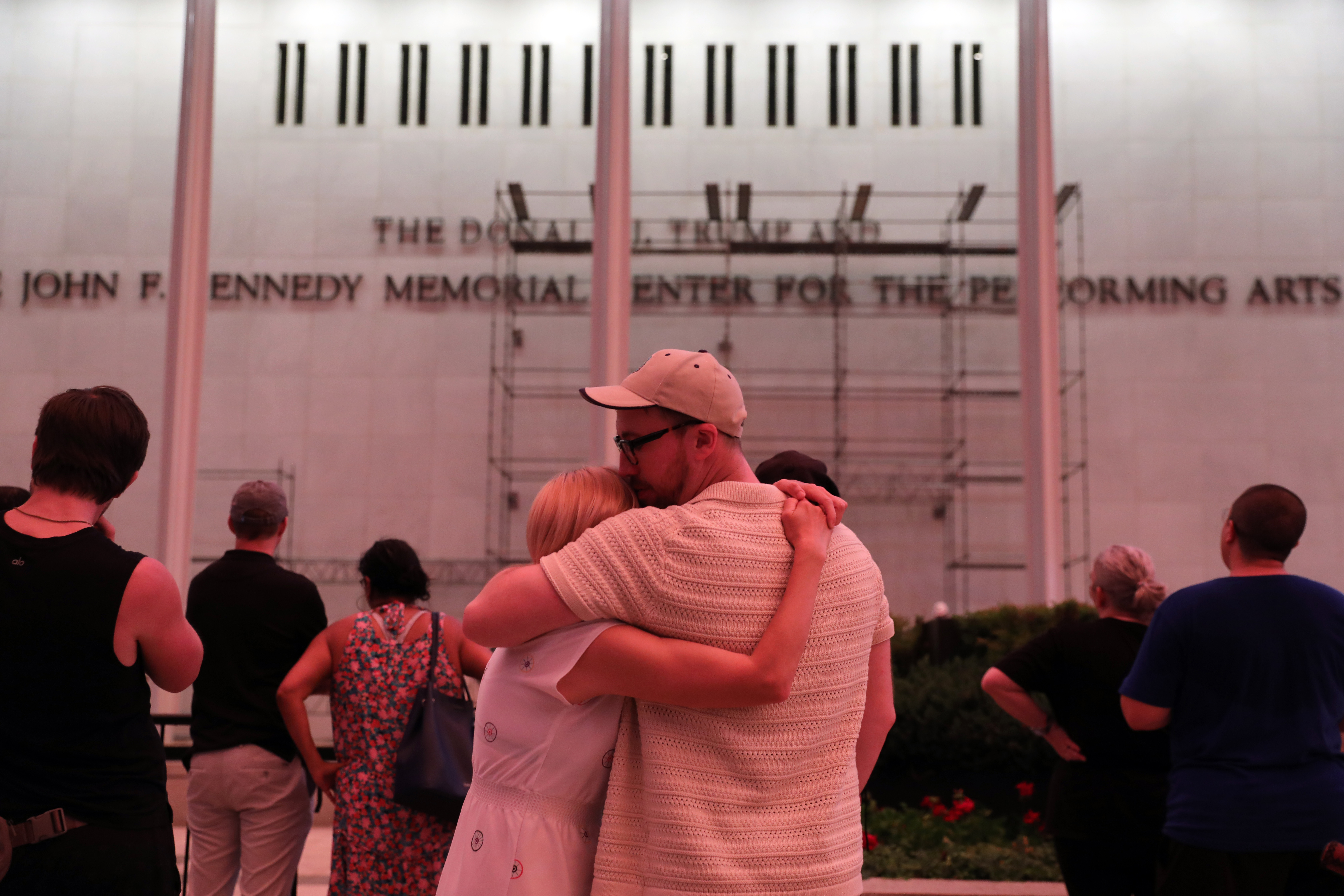
President Donald Trump’s name was removed from the Kennedy Center building in the early hours of Saturday morning, six months after it was added to the nation’s marquee cultural center, which Congress had designated as a living memorial to John F. Kennedy.
Workers spent Friday evening erecting scaffolding in front of the building as crowds gathered below to watch. The workers then covered the scaffolding with plastic to obstruct the view of the giant letters being removed.
The removal of Trump’s name came after a federal judge ordered the Kennedy Center to restore its original name by Friday. In recent days, Trump’s name had been removed from the center’s official website, phone voicemail, as well as YouTube channel. Last Thursday, an internal memo from the center’s Office of General Counsel and obtained by Politico directed staff to begin removing references to Trump from everything, from communication and promotional materials to signage.
Read more: All the Things Trump Has Put His Name and Face on as President
In December, the Kennedy Center’s Board of Trustees, which was packed with Trump’s allies, voted “unanimously” to rename the cultural center to the Trump-Kennedy Center. The move drew immediate backlash and a lawsuit from Rep. Joyce Beatty of Ohio, one of the board’s ex officio members, who was stripped of voting power on the board. Beatty was reportedly spotted in the plaza next to the Kennedy Center among crowds waiting for the removal to begin on Friday.
“Congress gave the Kennedy Center its name, and only Congress can change it, ” District Judge Christopher R. Cooper said in a 94-page decision in May, while adding that the decision made by the Board of Trustees violated “Congress’s unequivocal mandate.” Judge Cooper rejected a last-minute appeal from the board to keep the name, finding it unlikely to succeed.
Judge Cooper also reversed the board’s decision to shut down the center for two years beginning on July 5, but the internal memo disputed the judge’s ruling, saying the court “did not rule that the Center must stay open during the renovations” and that it would provide further guidance “shortly.”
Norman Eisen, one of the attorneys representing Rep Beatty, said in the latest motion filing that there is “serious reason for concern” that the center is “not undertaking a good faith effort to comply with the Court’s order.”
“It appears that Defendants’ General Counsel has told all staff that Defendants need not do anything to ensure the Center remains meaningfully operational after July 5, 2026, and can instead implement a total closure via inertia.”
The restoration of the iconic Kennedy Center’s name is perhaps the most visible example of the courts pushing back on Trump’s aggressive efforts to reshape wide swaths of the federal government and Washington, D.C. life.
In his second term, Trump has attached his name or image to U.S. passports, battleships, social welfare programs, and multiple federal buildings. Trump’s signature is set to appear on future U.S. paper currency, the first living president to choose to do so. The President also reportedly sought to name Washington Dulles International Airport and New York’s Penn Station after him, although neither transportation hub has changed its name yet.
Eisen tells TIME the fight to keep the Kennedy Center’s original name is about defending the rule of law and putting a check on Trump’s corruption, while also paying respect to the building’s namesake.
“What this also means to me is the protection of a memorial to a fallen president, someone who our nation mourns and misses, and the restoration of the building for artists and audiences alike, who fled when Donald Trump's name was slapped on there, and it was politicized,” he added.
Along with restoring the center’s name, Judge Cooper also reversed the board’s decision to shut it down for two years beginning on July 5. But the internal memo from the center’s Office of General Counsel disputed the judge’s ruling, saying the court “did not rule that the Center must stay open during the renovations” and that it would provide further guidance “shortly.”
Eisen, who also fought and successfully blocked Trump’s $1.8 billion anti-weaponization fund in court, points out that the center’s prior plan for renovation was to keep the center open while necessary maintenance is made, and that the judge has made it clear that the center must remain open.
“There's no need to close it, as far as we can tell, except to spare Donald Trump of the embarrassment that his name is toxic with artists and audiences,” Eisen says.


