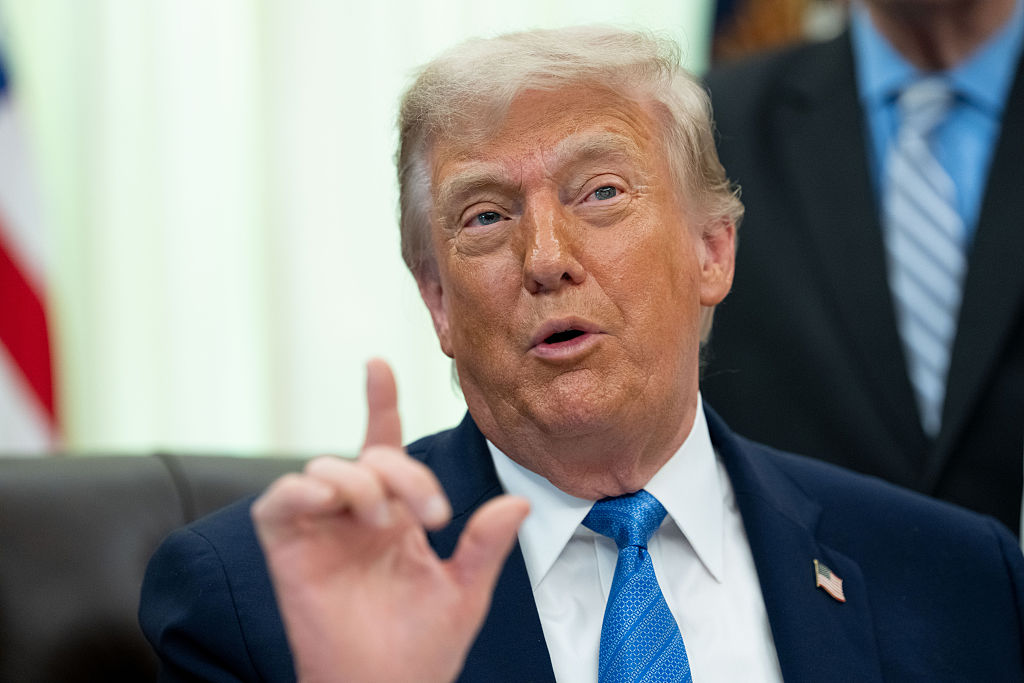
“You know what I really love?” President Donald Trump told reporters in the Oval Office Wednesday. “I love the inflation.”
Trump’s remark came as he was asked about the latest data from the Bureau of Labor Statistics, which showed the Consumer Price Index rising at a faster rate in May for the third consecutive month this year and the 4.2% increase from May of last year representing the first time inflation has topped 4% since 2023.
“The numbers were great,” Trump explained, seeming unusually optimistic about a metric that he’s long hammered Democrats on. The President clarified to the New York Post that he meant he “loved” that the figures weren’t any higher than they were, and he claimed that he was being taken out of context by political rivals.
“Trump really said, ‘I love the inflation.’ On camera. For all of America to hear,” Senate Minority Leader Chuck Schumer (D, N.Y.) posted on social media. Rep. Hakeem Jeffries (D, N.Y.), the House Minority Leader, similarly called Trump’s remark an “extraordinary” statement, adding that the only conclusion to draw “is that he doesn’t give a damn about making life better for everyday Americans.”
The President appeared to try to justify his “love” for the latest inflation figures as he continued speaking to reporters in the Oval Office, explaining that living costs were only being pushed up by the ongoing U.S.-Iran war, which has been driving up energy prices. “When the war is over? It’s going to come down like a rock,” Trump asserted, though it remains unclear when the conflict will actually come to an end.
Trump even claimed his Administration has provided some economic relief, pointing to more than 100 million of barrels of oil he said were obtained in a secret mission from the bottlenecked Strait of Hormuz—the waterway that Iran has choked off and through which a fifth of global oil production before the war passed through. Trump said the mission, which has not been verified, was the reason why oil barrel prices haven’t jumped to experts’ predictions of $250 and have stayed near $90.
Still, Trump’s apparent glibness comes as the Republican Party faces what could be challenging midterm elections, as the economy and affordability remain top concerns for voters. Results of an Economist/YouGov poll released Tuesday showed that 63% of Americans surveyed disapprove of how Trump has handled the economy. Consumer confidence has also dipped as the Middle East conflict persists.
Despite this, he’s continued to promise that prices will go back to pre-war levels. In the White House, he referred to a trip to Iowa in early 2026, during which he claimed to have seen gas prices at $1.85 per gallon: “We will be back at those levels very soon.”
What the latest figures state
According to the data released by the Bureau of Labor Statistics on Wednesday, the consumer price index—which tracks the price changes for a representative basket of goods—rose 4.2% in May 2026 from May 2025.
It’s the third straight monthly increase since February, when the Iran war broke out in the latter part of the month. Monthly, prices rose 0.5% last month, after rising 0.9% in March and 0.6% in April.
Energy costs are largely responsible for the rising index: the bureau said it accounted for more than 60% of the increase in all items. Energy prices rose 3.9% in May, after a whopping 10.9% increase in March and 3.8% in April. Food and energy prices are volatile—outside of them, the uptick in costs wasn’t as severe, at 2.9% year-on-year in May.
While inflation is still far below the most recent peak of 9.1% under former President Joe Biden in mid-2022, it is still above the Federal Reserve’s 2% target for price stability, though that target has been surpassed every month since March 2021. Higher inflation could lead to interest rate hikes, which may further diminish business and consumer sentiment and weaken the economy.
What Trump has said about inflation
Trump’s most recent response to inflation stands in contrast to his yearslong messaging when it occurs under Democrats.
When he campaigned for his second presidential term, he repeatedly pinned the blame for inflation on Biden rather than external circumstances. “We all knew that Joe Biden would be not so good, but few could have imagined that he would be such a disaster for this country, what they've done,” he said at a rally in Arizona in early 2022. At a 2023 Conservative Political Action Conference, Trump promised to “take care of inflation very, very quickly” if he became President.
After he won the 2024 presidential election, Trump brought back the use of tariffs against international partners, which economists warned could drive up prices of goods. But speaking to TIME earlier that year, he said he didn’t believe the levies would result in inflation. However, the tariffs did increase the price of goods, according to a study by economists at the Federal Reserve released this April.
Trump tried to embrace “affordability” in late 2025, as Democrats used it to campaign against the GOP, and the Administration even reversed some policies in an attempt to lower prices. But by December, as inflation continued to stay above targets, Trump called the issue a “hoax,” a “fake narrative,” and a “con job” manufactured by Democrats. “We’re the ones that are fixing it,” Trump added.


