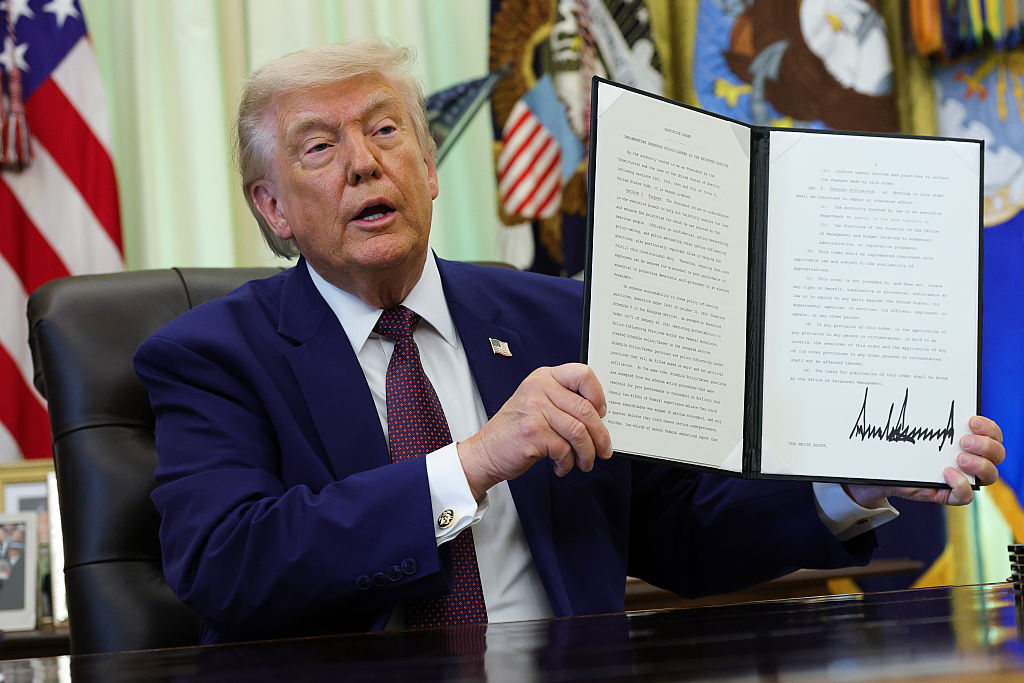
President Donald Trump on Wednesday signed an executive order that effectively makes it easier to fire thousands of federal workers in senior policy-influencing positions, part of his wider campaign to downsize the government workforce and ensure those that remain are aligned with his agenda.
The order reclassifies about 8,000 workers to a Schedule Policy/Career category created during Trump’s first days in his second term, covering positions with a “confidential, policy-determining, policy-making, or policy-advocating” nature. Roles listed under the category are at-will positions, meaning the government could fire them without a provided reason.
Almost all of the reclassified positions are at the highest pay grade for most U.S. civilian federal employees, GS-15, with some earning up to $200,000 annually. These cover positions such as directors, deputy directors, chiefs of staff, senior advisors and policy analysts, those involved in drafting regulations and guidance, public affairs and legislative affairs leaders, and those overseeing the disbursement of federal grants—of which the Administration has also recently proposed to increase oversight.
At the signing ceremony at the Oval Office, James Sherk of the White House Domestic Policy Council told Trump that the order treats the affected employees like private sector workers: “They’re going to be hired on the basis of merit and confidence, but if they’re messing up, then they can be removed quickly—rather than taking a year longer to get rid of them.”
Since returning to the White House last year, Trump has downsized the federal workforce by more than 300,000 people. But the number of positions affected by Trump’s Wednesday order is smaller than anticipated. The Office of Personnel Management (OPM), essentially the federal government’s human resources department, previously projected some 50,000 positions—about 2% of the federal workforce—would be impacted by the policy. Still, the Administration has not ruled out that more positions may be affected in the future.
The Wednesday order is the culmination of a move that has been anticipated for months, since the OPM’s rule on Schedule Policy/Career went into effect in March. While the jobs in the category remain career and nonpartisan, they will lose rights to exhaustive processes and appeals when they are removed, allowing for their quicker removal.
Everett Kelley, president of the American Federation of Government Employees, which represents about 800,000 federal workers, says the order enables corruption and discourages dissent by eliminating employees’ due process rights.
“The practical implications of this action are clear,” Kelley said in a statement Wednesday. “Workers who once felt comfortable reporting waste, fraud, abuse, and mismanagement at their place of employment because they were protected from retaliation will now be afraid for their jobs if they speak out.”
Speaking to reporters on a call, OPM director Scott Kupor highlighted the Administration’s need to employ workers to carry out the President’s policy agenda. The OPM director, however, denies that reclassified workers will be subject to loyalty tests or lose whistleblower protections.
“You can have any political views, but if you allow those views to basically interfere with your willingness to actually carry out lawful orders and policy directives with the administration, then this provides a mechanism obviously for people in those agencies to be able to be removed effectively at will,” Kupor said.
Wednesday’s order is a revival of the policy known as Schedule F, which Trump issued in the last few months of his first presidential term but only a few agencies considered complying with before the Biden Administration revoked it in 2021. That Trump order also effectively signaled that policy-influencing government workers should align with the President’s agenda or be removed.
But the OPM’s reclassification efforts have already faced multiple legal challenges before the Wednesday order. Skye Perryman, president and CEO of Democracy Forward, one of the organizations challenging the reclassification, said in a statement Wednesday that the country has long relied on a “professional, nonpartisan civil service.”
“When government experts can be fired without cause, it’s not just federal workers who are harmed,” Perryman added, “it’s the people across the country who rely on these essential services every day.”


