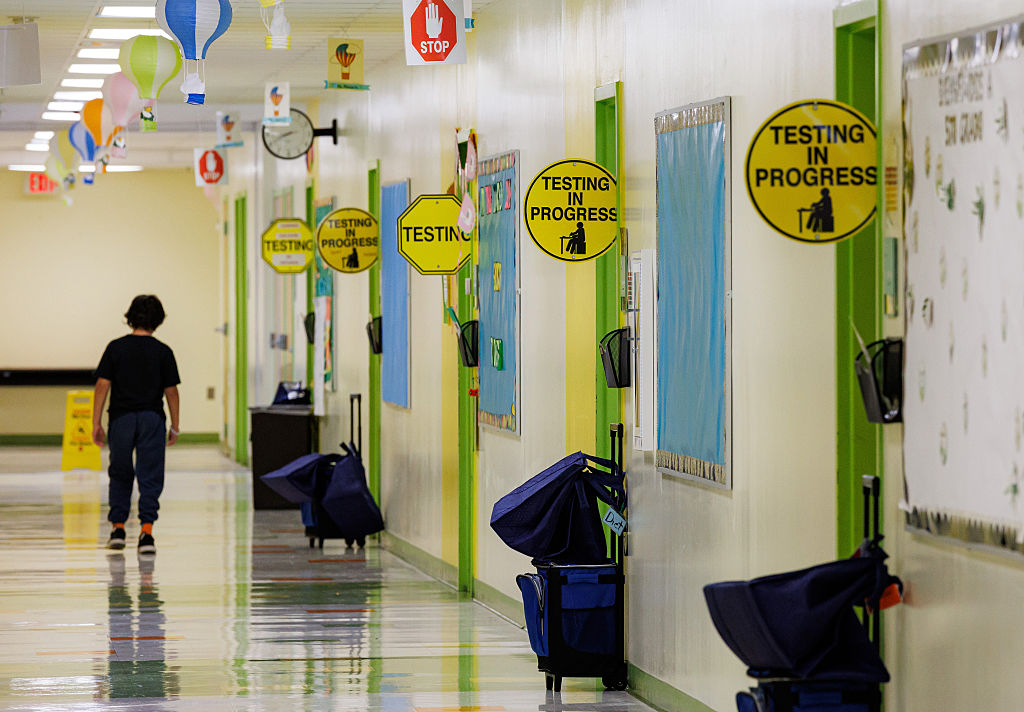
Over the past ten-plus years, American students’ academic achievement has experienced a concerning decline.
Test scores for students in grades K through 12 are lower than they were a decade ago in school districts across the U.S., according to new data released Wednesday by the Educational Opportunity Project at Stanford University.
Reading scores were down roughly 0.6 grades in 2025 compared to 2015, and math scores were down about 0.4 grades. This means that students were 60% of one school year behind where their peers were in reading a decade earlier and 40% of one school year behind in math.
The decline began even before 2015, according to a report on the data from the Education Scorecard, a collaboration between the Center for Education Policy Research (CEPR) at Harvard University and the Stanford project. From 1990 to 2013, students’ math and reading scores rose steadily. But in 2013, per the report, the U.S. “entered a learning recession” and the rate of improvement in reading and math began to flatten or drop, a trend that continued through the COVID-19 pandemic.
Read more: Here's How Much Progress Students Lost in the Pandemic
A post-pandemic assessment of reading and math achievement from 2022 to 2025 shows some rebounds in math achievement. Reading scores, meanwhile, continued to decline during that period, reaching their lowest point since 1990 in eighth graders and pre-2003 levels for fourth graders; only last year did some states start to see slight improvements.
And experts tell TIME that even with those recent improvements in scores, the U.S. still has a long way to go before students return to the level of achievement their peers were at 10 years ago.
“What the data highlight is this decade-long decline in academic performance in America,” Sean Reardon, the faculty director of the Educational Opportunity Project and professor at Stanford University, tells TIME. “We haven't as a nation focused on public education––on improving it in the last decade.”
Here’s what the data show, and what experts believe might have contributed to the decline in test scores—as well as what might be behind the partial recovery following the pandemic.
The “learning recession”
By 2013, following the steady, more than two decade-long rise in math and reading achievement, fourth grade students were scoring at a similar level in math as sixth graders in 1990 and reading rates had consistently been on the rise
But after spending such a long time on the upswing, the rate of improvement became negative in math and dropped to zero in reading between 2013 and 2015, and achievement continued to fall through the rest of the decade.
Then COVID-19 hit. While the rate of decline in reading scores remained steady before and during the pandemic, it “seemed to hasten the decline in math,” according to the Education Scorecard report.
The report cites two key factors as likely contributing to the slide in testing performance, stating that “the slowdown in learning coincided with a dismantling of test-based accountability and a rise in social media use.” The report goes on to describe test-based accountability in reference to past government programs from the early 1990s and 2000s that mandated schools to focus on methods that would boost students’ test scores. It is unclear which of the two, per the report, which has had a larger impact.
“The decline started around the time that social media’s use among teens was exploding, and this was also occurring in a number of other countries,” says Thomas Kane, one of the authors of the Educational Scorecard report and a professor at Harvard University.
Read more: Inside the Parent-Led Movement For Phone-Free Schools
He notes that “we actually don't fully understand all of the ways in which social media is affecting youth,” though use of such platforms has been shown to decrease students’ attention spans, disrupt sleep, and produce anxiety.
But he maintains that it is at the core of the decline in reading achievement. He points out that social media use was shown to be heaviest among the lowest achieving students.
“We've got to recognize that schools need to be focused on reading even more than pre-2013,” Kane says, due to the external effects of social media that he believes has fostered a culture in which students no longer read outside of the classroom.
“I think there are few things that are going to be more important to the long term success of the country than just focusing on teaching students to read.”
Recent improvements—but “a ways to go”
Math achievement rebounded “immediately” after the pandemic, per the Education Scorecard report, with students’ scores improving at the same rates in 2022-2024 as they were before 2013. Meanwhile, reading scores began to improve for the first time in a decade last year in some states.
“It's a promising indicator, but I think it's too soon to know if it's going to be sustained,” Reardon says about the post-pandemic improvements. “They're not big increases relative to the declines, but it's the first time in the decade we've seen reading scores go up.”
The increases have also been unevenly distributed. The report describes recovery rates in reading and math since 2022 as “U-shaped––with larger improvements among the highest and the lowest income school districts in the country.”
The recovery in achievement rates in the highest poverty districts, the report notes, seems to largely be due to federal relief funds given to state and local governments that were impacted by the COVID-19 pandemic.
“The highest poverty districts had the federal dollars,” Kane says. “The highest income, lowest poverty districts had their own dollars.”
Meanwhile students in middle-income districts, in which 30 to 70 percent of students receiving federally subsidized lunches, have seen the least improvements.
These districts “didn't have their own community resources to help students catch up,” as a consequence of not receiving the same federal funding as lower-income areas, Kane says.
When it comes to the gap between the quicker rebound in math and the more recent increase in reading achievement, Reardon speculates that one of the reasons math scores rebounded markedly in 2022, while reading scores didn’t, is because many school districts around the country invested in tutoring and summer schooling, which he says tend to focus on and be more effective in math.
Read more: How Schools Are Working to Help Kids Recover From Pandemic Learning Loss
At the same time, however, persistently high student absence rates have continued to hamper progress in math in particular, according to the report. In 2024-2025, 23% of students were frequently absent, compared to roughly 15% before the pandemic.
The report contends that academic recovery post-pandemic would have been “meaningfully larger” for all income levels if student absences returned to pre-pandemic rates.
“Absence rates remain high and so students aren't going to catch up in math if they're not sitting in classroom seats,” Kane tells TIME.
The more belated rebound in reading scores, meanwhile, has been linked to literacy programs.
The report states that this “incipient recovery in reading appears to be related to state early-literacy reforms” in states including Maryland, Louisiana, Tennessee, Kentucky, Indiana, Mississippi, Montana, and the District of Columbia.
“None of the states which had eschewed literacy reforms” as of January 2024 improved in reading between 2022 and 2025, it adds, pointing to Massachusetts, California, Washington, New Hampshire, Georgia, Wisconsin, Rhode Island, New Jersey, Hawaii, and South Dakota.
Notably, however, many states that were implementing such reforms had also not yet seen turn-arounds in reading scores as of last year.
Kane argues that state and local leaders must implement reforms to address the decline in academic achievement, like those whose literacy programs helped spark recent upticks in reading scores.
“It's all up to state leaders, and it's not just a matter of passing legislation,” says Kane. “It's about following through on implementation and fundamentally changing how we think about teaching reading and literacy instruction in schools.”.
Despite the small recent improvements, Reardon emphasizes that there’s a long road ahead.
“We've had a 10 year decline, and so while there's promising signs in the last year in reading, and the last couple years in math, we still got a ways to go to get back to where we were 10 years ago.”


