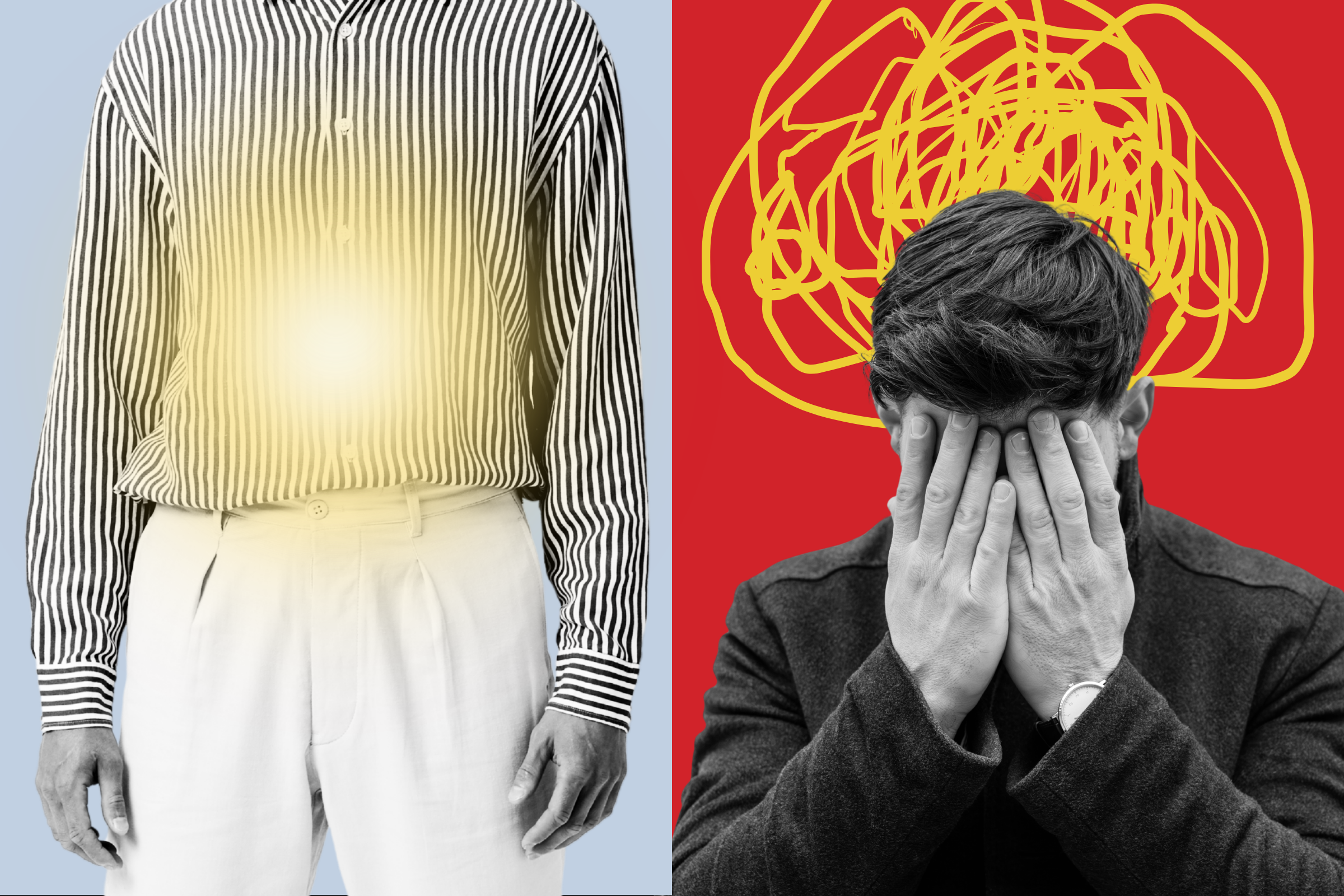
Trust your gut. Listen to your inner voice. Follow your instincts. If you’ve ever faced a big, difficult-to-make decision, you’ve probably heard comments like these. The advice to tap into your intuition or gut response is often intended to “help guide decision-making, so people can sort of use their own internal cues,” says Kristen Lindquist, a professor in the department of psychology at The Ohio State University.
There isn’t scientific consensus on what intuition is, exactly, or even how reliable it is. But many people believe their inner voice is worth paying attention to: A 2026 survey conducted by Talker Research found that 71% of adults report listening to their intuition at least some of the time.
However, anxious or intrusive thoughts can also show up as inner voices, making it hard to decipher whether you’re experiencing anxiety or clear awareness. “It’s very common for people to mistake them,” says Dr. Judson Brewer, director of research and innovation at Brown University’s Mindfulness Center. For example, a person who is feeling anxious about an upcoming flight might confuse their stress and worry for intuition warning them not to get on the plane. Someone debating a job offer might doubt whether they’re making a decision based on what “feels right” or fear.
It’s a common yet underexamined question, says Debra Kissen, a clinical psychologist in Illinois and founder of Light On Anxiety Treatment Centers. “When do we listen to our wisdom—the more mystical parts of ourselves that know things? And when is it an intrusive thought, and the harm of just giving it too much power starts taking away from your life?”
How psychologists define intuition
Though many people believe in the power of intuition, it isn’t a concept that’s been clearly defined or backed by research. “It's hard to study intuition from a scientific standpoint,” says Brewer, “but it doesn't mean that it's not a real thing. I think most people have had pretty clear bouts of it.”
There’s a concept in lay psychology of a gut response or inner voice, Lindquist explains, which is “whether or not people use something like a feeling to guide their behavior.” For some people, being able to hear this inner voice “can be really helpful in the noise of so many different opinions,” says Debra Kissen, a clinical psychologist in Illinois and founder of the Light On Anxiety Treatment Centers.
Read More: A Few Minutes of Coloring Can Erase Your Stress
But while tapping into an inner voice may help some people make decisions, intuition isn’t infallible. Trusting your gut “is based on sort of emotional thinking rather than rational thinking, and intuition is subject to a lot of errors,” says David Barlow, founder of the Center for Anxiety and Related Disorders at Boston University.
There have been a number of studies showing that people can exhibit racial biases when prompted to make decisions based on quick gut-feel. “That’s an example of how one of these gut responses can really go awry,” says Lindquist.
Anxiety vs. intuition: How to tell them apart
No matter how much stock you place in intuition, making decisions when you’re feeling anxious usually isn’t productive, experts say. “An anxious moment is a very hard time to try to find what your wise mind might be thinking,” says Kissen. To determine whether a thought or feeling is coming from a place of anxiety, ask yourself these questions:
How do I feel?
A tight chest, fast-beating heart, sweaty palms, and muscle tension are more likely to accompany anxious thoughts, says Judith Beck, a clinical professor of psychology in psychiatry at the University of Pennsylvania and president of the Beck Institute. “When we were cavemen, it was very helpful for us to have anxious thoughts if we heard a rustle in the bush, because if we thought, ‘What if that’s a tiger?’ then our body is going to be primed for action.” In the present day, “our brain doesn't necessarily differentiate between false alarms and true alarms,” she explains, and the body may still tense up even though real danger isn’t there.
Does the thought make you feel open or closed?
In his lab, Brewer has been studying different categories of experiences people can have with emotional states that make them feel either open and expanded, or closed and contracted. Emotions like frustration usually make people feel contracted; kindness or curiosity make them feel open. “We’ve done studies with hundreds of people now where anxiety is always reported as closed and contracted,” he says, “and when somebody is really in tune with themselves and with the world,” which might be the case with intuition or an inner wisdom, “then their experience is reported as more open.”
Read More: 8 Signs You’re the Problem in Your Arguments
Is the thought urgent?
“Sometimes I’ll tell my patients that we can know we’re more in anxiety territory vs. more of a pondering when there’s an urgency,” says Kissen. This might be especially true when someone is experiencing a compulsion, she adds, which often signals to the brain that you must do something immediately or risk a negative outcome. (Thinking, for instance: If I don’t call my mom right now, something bad will happen.)
Is the thought negative?
“Anxiety thoughts are always negative predictions,” says Beck. (What if I fail? What if no one comes to my party?) But if you’re experiencing a calm inner voice, the thought could be either negative or positive, she says, and might speak to you differently. “One of the biggest differences between intuition and anxiety is if you have an intuition, you're more likely to say to yourself, I have a feeling that…” (For example: I have a feeling they’re planning a party for me.)
How to calm anxious or intrusive thoughts
If you’re experiencing persistent, overwhelming anxiety, working with a specialist in cognitive behavioral therapy (CBT) can be highly effective, according to the American Psychological Association. This form of psychotherapy helps people better understand anxious thoughts and learn ways to manage them more effectively. Additionally, experts recommend these strategies to calm anxious thoughts in the moment:
Take a pause
Anxious or intrusive thoughts often demand action, but real wisdom “should guide us in a way that feels healthy, not just rapid,” says Kissen. In other words, sit with the feeling without acting right away, even if that feels uncomfortable. “Slow it down to notice [the thought], and then we can decide [what to do],” she says.
Read More: The 3 Words You Should Never Say to Someone Going Through a Hard Time
Release the tension
Controlled, deep diaphragmatic breathing exercises have been found to help calm the fight-or-flight response, including spiking cortisol levels, that can make you feel tense when you’re experiencing anxiety. Beck also recommends a technique called progressive muscle relaxation, “where you are alternately tensing a set of muscles and then releasing them” to reduce physiological symptoms of anxiety.
Be realistic about the worst-case scenario
Anxiety often involves lots of catastrophic thinking, “so a really good question to ask yourself is, ‘OK, what's the worst that could happen, and if it happened, how would I cope?’” says Beck. Accurately assessing risk can help put anxiety into perspective, experts say. Think through the probability of that worst-case result happening, and if it were to, “say, ‘Would that be the end of the world?’” asks Barlow.
Label the feeling
Some therapists use an approach where they train patients to recognize anxious thoughts as merely thoughts, explains Brewer, “and that helps some people to step out of it and kind of observe.” By looking at an anxious thought like an outsider would (“This could just be my anxiety talking,” for instance), you might be able to evaluate whether a thought is one worth following or not.


