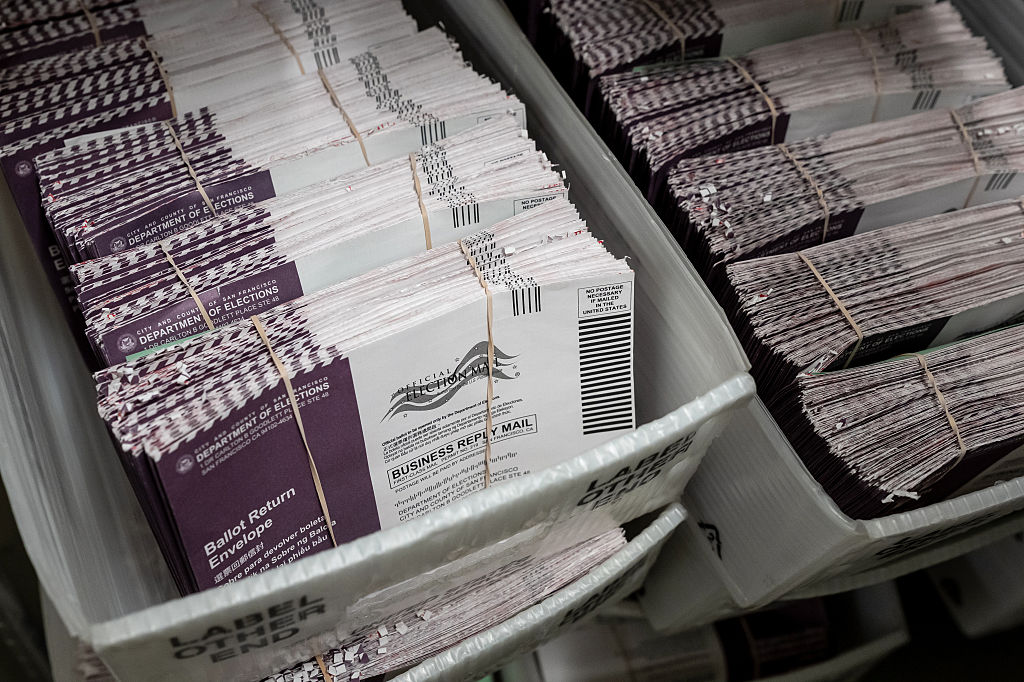
President Donald Trump’s Administration is seeking the Supreme Court’s intervention to push his election reform agenda ahead of the November midterms—by allowing nationwide implementation of an Executive Order restricting mail-in voting.
In a Monday filing, the Justice Department requested the high court put on hold a district court ruling that prevented the enforcement of Trump’s order. The order, issued in March, directed the Department of Homeland Security and the Social Security Administration to compile lists of eligible voters per state and forbade the U.S. Postal Service from sending absentee ballots to anybody who isn’t on a state’s mail-in or absentee participation list.
Democratic officials in 23 states and the District of Columbia challenged Trump’s order, alleging unconstitutionality and presidential overreach, and last month, an Obama-appointed federal judge in Massachusetts blocked parts of the order for those states for the November election. A Massachusetts-based appeals court rejected the Administration’s request to pause that injunction pending appeal, though the appellate court’s panel was divided: two Biden-appointed judges formed the majority, while a Trump appointee concurred in part and dissented in part.
Solicitor General D. John Sauer sought an immediate administrative stay on the district court’s injunction pending the resolution of its appeal.
In the filing, Sauer argued that the district court “lacked jurisdiction to resolve this premature dispute,” as the agencies concerned have yet to finalize their implementing policies based on the Executive Order. In early June, the Postal Service proposed amending its rules to comply with Trump’s order. At a Senate hearing later that month, Postmaster General David Steiner confirmed that if enacted, mail-in ballots would not be delivered in states that refuse to share sensitive voter information with the government.
Sauer also claimed in the filing that the injunction “imposes irreparable harm on the government” as it “impedes the President’s ability to oversee the Executive Branch,” and an administrative stay is warranted to give agencies enough time to implement those policies.
Justice Ketanji Brown Jackson requested the Democratic-led states that are suing to respond in writing by next Monday.
Trump's Executive Order on mail-in ballots is part of his broader efforts to remake U.S. elections, as he spreads false claims of widespread voter fraud. He has described mail-in voting as “rigged” and “corrupt as hell,” and he has incorrectly claimed that the U.S. is “the only country in the world that does it that way.” Despite the President’s repeated attacks, however, there is widespread evidence that mail-in voting fraud is extremely rare and that states have adequate safeguards to curb it.
Nonetheless, Trump is keen to end the use of broad, no-excuse mail-in ballots nationwide before November, which could disproportionately benefit the GOP, as some studies show Democratic voters have been more likely to use mail-in ballots compared to Republicans.
The President has also pushed Congress to pass the SAVE America Act, which includes controversial voter-identification requirements, even threatening not to sign other bills into law until it passes. And earlier this month, in a primetime speech to the nation, Trump outlined claims of Chinese interference in the 2020 election to make the case for his preferred election reforms.
Some Republican Senators have called for canceling an August recess to try to ensure the voter ID bill passes. But the bill has stalled in the upper chamber of Congress, putting Trump at odds with Senate Majority Leader John Thune, who argues that Republicans lack the numbers to pass it without eliminating the filibuster, which Thune has said would be a “bad idea.”


