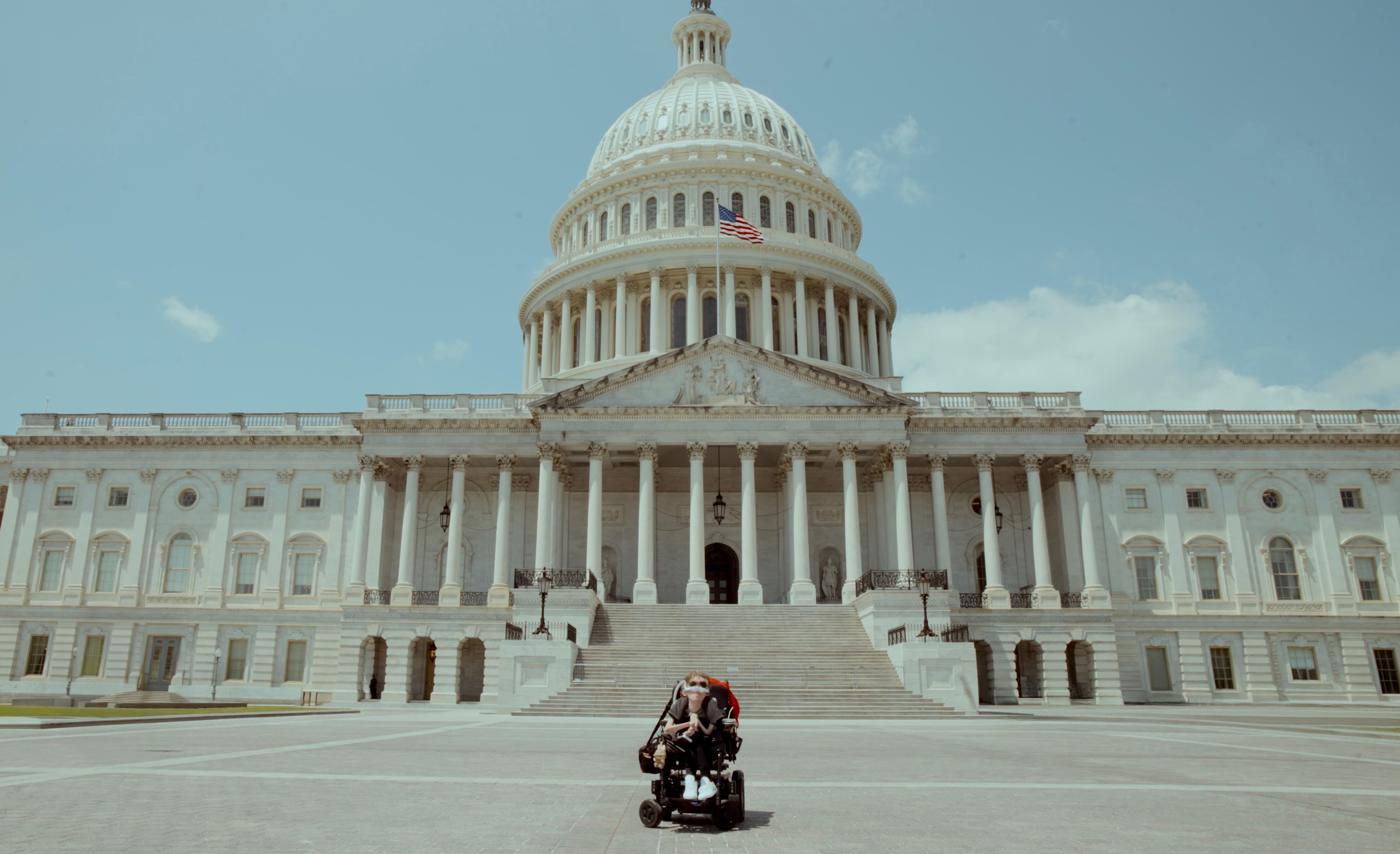
I’m an actor. I also use a motorized wheelchair and a ventilator, and both of them run on Medicaid. The machine that pushes air into my lungs, the chair that moves me across a room, and the aide who gets me out of bed so I can do my job and be on television are all paid for by Medicaid. Without that coverage, I wouldn’t have a career. Instead, I would have a massive life crisis.
I’ve spent this year in a split-screen. On one side, I’ve had the best professional run of my life. On the other, a law that’s starting to take shape is threatening to make people like me suffer and disappear.
That contradiction ultimately comes down to how much our country believes a disabled person is worth.
On July 4, 2025, President Donald Trump signed the One Big Beautiful Bill Act. By the Congressional Budget Office’s own accounting, its Medicaid provisions cut around $1 trillion in federal spending over a decade, and will leave an estimated 7.5 million more people uninsured by 2034. Count the rest of the law’s health provisions, and the coverage loss climbs to an estimated $10 million. The Center for American Progress notes the spending cuts almost exactly match the law’s other half: about $1 trillion in tax cuts flowing to the top 1% of households, nearly half of that to roughly 200,000 households making more than $2 million a year.
Approximately a trillion dollars taken from the care of poor and disabled people, and roughly a trillion handed to the richest households in the country.
Then, there’s the cost no budget table ever lists. Before the bill reached its final, larger form, three physician-researchers published a peer-reviewed analysis in the Annals of Internal Medicine projecting what the cuts would do to actual lives. Their mid-range estimate:16,642 additional preventable deaths a year.
If the losses fall hardest on disabled, high-cost enrollees rather than spreading evenly, the cuts could go even deeper. In a law built to find savings, the most expensive bodies to keep alive are the most efficient place to look. The math suggests that I cost a lot, and the bill was written by people looking for things that cost a lot.
We must not trade disabled peoples’ lives in exchange for tax cuts for the ultra-wealthy. And we must not sacrifice all of the progress the U.S. has made.
On July 26, 1990, a Republican president signed the Americans with Disabilities Act (ADA), the world’s first comprehensive civil rights law for disabled people, and a law older than me. George H.W. Bush stood on the South Lawn and promised disabled people “independence, freedom of choice, control of their lives, the opportunity to blend fully and equally into the rich mosaic of the American mainstream.”
Yesterday marked its 36th anniversary. The show I’m proudly in, Furious, premieres today.
The ADA said disabled people have a right to live in America. The new law cuts the exact funding that helps many of us live, including the home-based services that keep disabled people like myself out of nursing facilities and in their own homes, which is the precise independence the ADA was written to protect.
Representation has quietly become a consolation prize. Even though the percentage is still low, there are more disabled people on television than ever, and I’m grateful to be one of them. But the applause and the cuts are happening simultaneously, to the same people, and almost no one with power experiences that as a contradiction.
You can be celebrated on a streaming service and defunded by a signature in the same summer. The issue: being seen is not the same as being kept alive.
Many people genuinely believe those are the same thing. Visibility is a form of protection and a society putting disabled people on television would surely not also strip away the thing that gets them out of bed. It’s a comforting belief, but in modern America, it is false. Visibility is cheap. It costs the country nothing. Care is what costs, and care is what was cut.
America has gotten very good at the gesture of inclusion and very comfortable with the substance of abandonment. Too often, we perform the first loudly enough to drown out the second.
Disabled people see this gap with clarity. I’m telling you what it looks like from here because the view is unobstructed, and because I am, for now, still in a position to describe it.
I’ll spend this month promoting a television show, marking 36 years of a promise, and watching my own healthcare coverage get more precarious, doing the arithmetic on my care in the back of my mind while I smile for cameras. I’ve got some great red carpet one-liners lined up.
I’ve built a career on finding the joke in exactly this kind of absurdity, and I have to find it here, because the alternative is worse.


