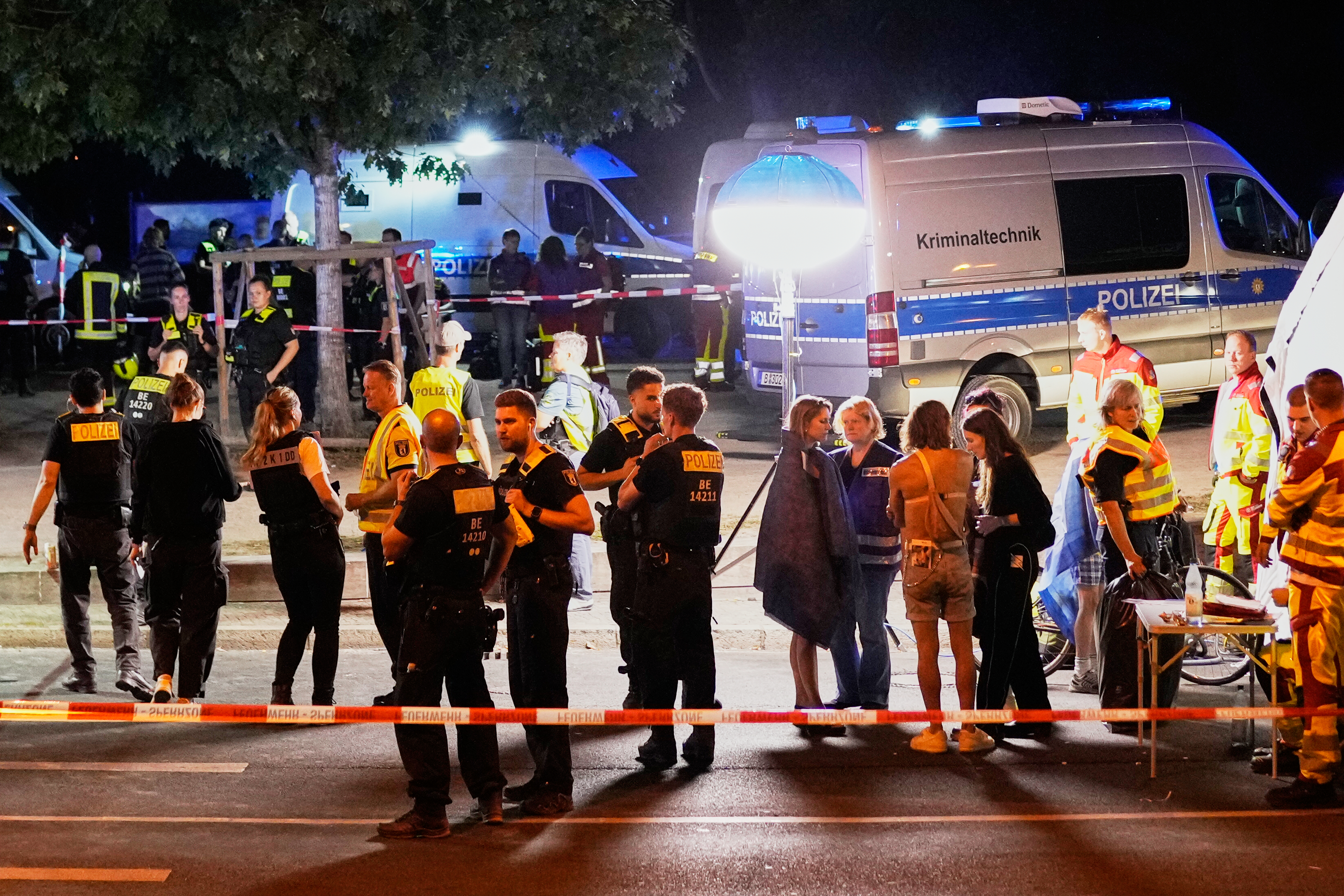
Authorities shot and killed the suspect believed to be responsible for a deadly attack at Berlin Pride on Saturday, according to police. The suspect, identified Sunday as Abdul Ballout, allegedly plowed a vehicle into a crowd of revelers, leaving one woman dead and at least 29 injured. Officials have said that the attack was likely motivated by Islamist extremism.
“According to current findings, he is said to have rushed toward our emergency forces with a stabbing weapon, after which police firearms were used,” the Berlin Police said in a post on X, confirming that the confrontation occurred at approximately 6 p.m. local time Sunday. It went on to say that resuscitation efforts at the scene proved unsuccessful.
Suspect Believed Responsible for Deadly Attack on Berlin Pride
The confrontation followed a nearly daylong manhunt. Alexander Dobrindt, the German Interior Minister, said at a press conference on Sunday that “large-scale” search operations spanned train stations, airports, and the borders, as officials searched for the man seen fleeing the scene following the previous evening’s deadly attack.
The incident occurred around 10 p.m. local time, promptly ending the remainder of the scheduled events for the nation’s annual Christopher Street Day celebration. The LGBTQ+ event, also referred to as Berlin Pride, is named for the New York City street that hosted the 1969 Stonewall riots—widely credited for launching the modern gay rights movement. The festivities included a concert on Saturday evening near Tiergarten, a large park in the center of the city.
As hundreds of thousands gathered, a white minivan plowed through a side street adjacent to the park, striking pedestrians before crashing into a tree. The driver exited the vehicle and may have continued his assault on foot before fleeing the scene. Authorities believe he wielded a stabbing instrument, due to the nature of the injuries sustained by several passersby after the suspect exited the van.
“Everything we are seeing here indicates an Islamist terror attack,” Dobrindt said early Sunday.
Read More: Why Car-Rammings Are on the Rise—and So Hard to Prevent
A Berlin Police spokesperson told reporters in the immediate aftermath of the attack that there had been coordinated security measures in place for the Pride event.
"We meticulously prepared this event together with the organizer. We have an incredible number of personnel deployed,” he said, noting that extensive access barriers had been set up to prevent vehicles from entering the event grounds.
A Berlin Fire Service spokesperson told media outlets at the scene that at least 11 victims suffered life-threatening or serious injuries. None of the victims have been publicly identified.
“Berlin is the city of freedom—and our freedom has been attacked in the most horrific way today,” Berlin Mayor Kai Wegner said in a statement Sunday, while promising that authorities were responding to the suspected terror attack with “utmost urgency.”
Later that evening, Wegner confirmed to German broadcaster rbb that the suspect “had been apprehended.”
"The fact that the Berlin police have the suspect within 24 hours is a major success for the investigating authorities," he said.
Who Is Abdul Ballout?
Police on Saturday released a photo of the suspect who was originally identified only by his first name and last initial, in compliance with German privacy laws. “Abdul B.” was described as a 21-year-old German-born citizen. Police described him as having a slim build, with black hair, and standing approximately 1.9 meters tall (6-foot-2). He was last seen wearing a black hoodie with white pants, per the police report.
Dobrindt said on Sunday that “the suspect has in the past come to the attention of authorities.”
“He has committed various crimes. He has been radicalized in the past. He belongs to the Islamist scene,” Dobrindt continued.
The Berlin Public Prosecutor’s Office released additional details Sunday evening, upon taking over the investigations. It said that Ballout had been found guilty of assaulting a victim in a schoolyard in 2019 and of robbing an individual, along with an accomplice, in 2020. He was then convicted of assault and robbery in juvenile court in 2022.
Ballout allegedly “developed the desire to join the armed struggle of ISIS” in 2025, the press release continued.
He traveled to Lebanon and allegedly attempted to contact ISIS there, it said, but was arrested and sentenced to three months’ imprisonment for “incitement to religious and sectarian conflict.”
According to prosecutors, he returned to Germany after his release and was placed under arrest. The court had “found it proven” that he had published Islamic State propaganda on his Instagram account in 2024. In May 2026, he was sentenced to 22 months in prison. The court considered suspending the sentence because of the time he had already spent in pretrial detention and in prison in Lebanon. He was released under probation supervision while a final decision on the suspension was delayed for six months.
“The Public Prosecutor's Office had requested a longer, non-probationary sentence for the juvenile and the continuation of the arrest warrant,” its press release on Sunday evening said.
Police searched his address on July 3 upon suspicion of a Weapons Act violation, but only discovered a toy gun, so “the case was subsequently dismissed,” the statement continued.
That same residence was searched following the Berlin Pride attack early Sunday, but the suspect was not on the premises.
Is the Attack Part of a Larger Pattern of Extremist Terrorism in Germany?
The threat level in Germany remained at its recently declared “high threat level” on Sunday. It was established after intelligence pointed toward potential attack plans, according to the Interior Ministry.
Investigators had not determined whether Ballout acted alone as of Sunday evening. Police said they had not ruled out additional suspects.
“According to the current state of the investigation, there is at least one suspect,” the Berlin Police department posted while seeking public assistance. Dobrindt also commented on Sunday, “We cannot rule out the possibility that further terror attacks and such terrible acts might take place.”
The heightened threat level aligns with assessments published in the June 30 publication of the Bundesamt für Verfassungsschutz (BfV) Annual Report on the Protection of the Constitution, which states that "the threat posed by Islamist terrorism in Germany remains high." The report is part of a greater effort by the intelligence organization to “raise awareness about the level of threat posed to state and society.”
Its data shows that while the Islamic extremist following in 2025 was composed of 28,645 individuals (up from 28,280 the year prior), approximately 9,110 of them were “violence oriented” (down from 9,540 in 2024).
German intelligence has long warned that hostility toward LGBTQ+ people is "an integral part of all Islamist extremist ideologies," though the motives for the Berlin Pride attack have yet to be determined.
The BfV report explains that extremists see tolerance toward sexual and gender diversity as an imported Western value “which allegedly aims at destroying the Islamic community.”
“Against this backdrop, Islamist extremists spread hate propaganda and systematically exploit this topic as an additional field of agitation in their fight against supposedly morally ‘misguided’ Western values,” it continued.
Government representatives sought to reassure the public later that day in light of the latest assessments.
“Let us not be afraid,” German Chancellor Friedrich Merz said in a public statement on Sunday afternoon. “These actions have one aim. They want to divide our society. They want to take away from us our most important assets: our openness, and our freedom.”
He also expressed support for the victims and their families and gratitude toward first responders on the scene, assuring that authorities would move quickly to capture the suspect.
“There are more of us, we are stronger, and we will stay together,” he said, addressing his countrymen. “That is the most important thing in such a difficult hour.”



